Startup Data Room Checklist for Pre-Seed and Seed Founders
A practical startup data room checklist for pre-seed and seed founders: what to prepare, what to share later, and how to keep diligence organised.
Most early-stage founders do not need a huge data room.
They need the right documents, kept current, named clearly, and shown to the right person at the right time.
That is the difference between a room that reduces doubt and a room that creates work.
The 60-second checklist
Before you send a data room, make sure you can answer “yes” to these questions:
- Is the current pitch deck the same version your investor has already seen?
- Do the cap table and signed financing documents reconcile?
- Are cash, burn, runway, and the forecast clearly dated?
- Are founder, employee, and contractor IP documents where you can find them?
- Does each active investor have only the access they need right now?
- Does every important file have an owner and a last-updated date?
If any answer is no, fix that before adding more folders. A compact, current room is more useful than a complete-looking but unreliable one.
This is a US/startup-oriented working checklist, not legal, tax, or investment advice. Your jurisdiction, stage, and investor requests determine the final diligence list; involve qualified counsel for legal documents and disclosure decisions.
What a data room is for
A startup data room exists so investors can verify a few basic things:
- the company is legally in order
- the financial story is credible
- the product and traction story makes sense
- the team and IP are clean
- the main risks are understandable
That is the job: give serious investors one clear, controlled place to verify the parts of the business they need to review.
Not “upload everything you have ever created.”
Not “turn your Google Drive into a museum.”
The Minimum Viable Data Room
If you are pre-seed or seed, start here.
1. Company documents
Include:
- certificate of incorporation or formation documents
- bylaws or operating agreement
- board consents or approvals
- any key governance documents
This tells investors the company actually exists and can issue securities. One detail founders miss: the legal entity name needs to match exactly across every document in the room. A mismatch between “Acme Inc.” on your cap table and “Acme, Inc.” on your certificate of incorporation is a small thing that still gets flagged, and it is one of the fastest ways to make a lawyer start reading everything else more carefully.
2. Cap table and financing
Include:
- current cap table
- SAFE or note documents
- option plan summary
- prior financing documents
This is where investors check whether the paperwork matches the story. Before you share, verify that every SAFE or note listed in your cap table has a matching signed document, and that the fully diluted ownership view—including any unallocated option pool—reconciles correctly. If something does not line up, resolve it with your counsel before the room becomes active.
3. Financials
Include:
- current cash balance
- burn
- runway
- monthly financial snapshot
- basic forecast with assumptions
For a seed round, YC advises founders not to overbuild diligence material before the conversation warrants it. Start with a coherent deck and concise financial picture, then add depth as the investor’s review becomes more serious.
Make the monthly snapshot concrete: revenue, gross margin, burn, and cash balance, side by side, so an investor can understand the trend without a separate walkthrough. Label the runway method and forecast assumptions—such as planned hires, expected close date, and the drivers behind growth—so the numbers can be reviewed in context.
4. Product and traction
Include:
- pitch deck
- demo link, if relevant
- traction summary
- KPI definitions
- roadmap, only if it helps
Define your metrics once, in one place, and use the same definitions in the deck and the room. What counts as an “active user” or a “customer” should not shift between slide 8 and the traction folder. The right metrics also depend on your model — SaaS founders should lead with MRR/ARR and net revenue retention, marketplaces with GMV and take rate, consumer products with DAU/MAU and retention curves by cohort. If the deck says one thing and the room says another, investors notice, and it is usually the first crack in an otherwise strong story.
5. Legal and IP
Include:
- founder IP assignments
- contractor IP assignments
- employee IP agreements
- major customer or vendor contracts
- any material legal issue worth disclosing
IP ownership deserves early attention. If a founder, employee, or contractor created material work for the company, make sure the relevant agreements are signed, stored, and reviewed by counsel. Missing or unclear assignments can create diligence questions at exactly the point when you want the process to move smoothly.
The Access Mistake Almost Everyone Makes
The instinct is to build one data room and open the whole thing to every investor the moment they show interest.
That is usually the wrong move. Not every investor at every stage needs to see everything.
A staged structure works better:
- First conversation — pitch deck and executive summary only
- Real interest — full financials, cap table, and traction data
- Term sheet or final diligence — legal documents, contracts, employment agreements, and anything else sensitive
This does two things. It keeps a casual early conversation from turning into a full legal review before either side has earned it, and it means the version of your materials that circulates widely is the safe one, not the one with sensitive contract terms in it. If your sharing tool supports link-level permissions or expiration, use them — it is a lot easier to keep a data room clean by controlling who sees what and for how long, rather than trying to remember who has an old copy of what.
What Usually Gets Messy
The painful problems are rarely dramatic.
They are boring:
- stale cap tables
- missing signatures
- outdated financials
- unclear IP ownership
- metrics with no definitions
- files named like
final_actual_latest2.xlsx - a cap table that doesn’t reconcile with the SAFEs actually on file
- personal expenses mixed into company financials
Those details sound small until you are mid-round and multiple firms are asking for the same documents.
A Better Folder Structure
For most early-stage rounds, five folders are enough:
- Company
- Financing
- Financials
- Product and traction
- Legal and IP
That is enough structure to be useful without becoming a project of its own.
When the round gets deeper, you can add a second layer:
- customer references
- board materials
- option paperwork
- material contracts
- hiring plan
- detailed forecast
What Investors Actually Want
Investors are not looking for volume.
They are looking for confidence.
That usually means they can quickly answer these questions:
- Is the company real?
- Is the story consistent?
- Are the numbers believable?
- Is the team in control of the basics?
- Is there anything hidden that should worry us later?
That is why a smaller, cleaner room often performs better than a bloated one.
A 24-Hour Pre-Share Audit
Before you send a data room link to a new investor, run through this quickly:
- Do the numbers in the deck match the numbers in the financials, exactly?
- Does the cap table add up to 100%, including the unallocated option pool?
- Is every file named with a date and a version, not “final” or “latest”?
- Is anything in the room that shouldn’t be — old drafts, unrelated files, someone’s personal information?
- Has access been reviewed, so only investors who are actually still active in the process can see it?
This is a short, repeatable check before each new share. It is far easier to correct a stale file or unclear permission before an investor finds it.
Naming Conventions That Save Time
Use filenames that tell the truth quickly.
Good:
2026-07 cash-burn-runway.pdfcurrent-cap-table.xlsxfounder-ip-assignments.pdfpitch-deck-v3.pdf
Bad:
final_actual_latest2.xlsxdeck_new_new_edited_final.pdfroom stuff maybe
Small details matter more than founders think. An investor is usually comparing your materials against several other decks in their pipeline at the same time — a clearly dated filename signals you take the process seriously, and a folder full of “final_final” files signals the opposite, whether that’s fair or not.
Deckly Angle
This is exactly the kind of workflow Deckly is meant to support.
The point is not just storing files.
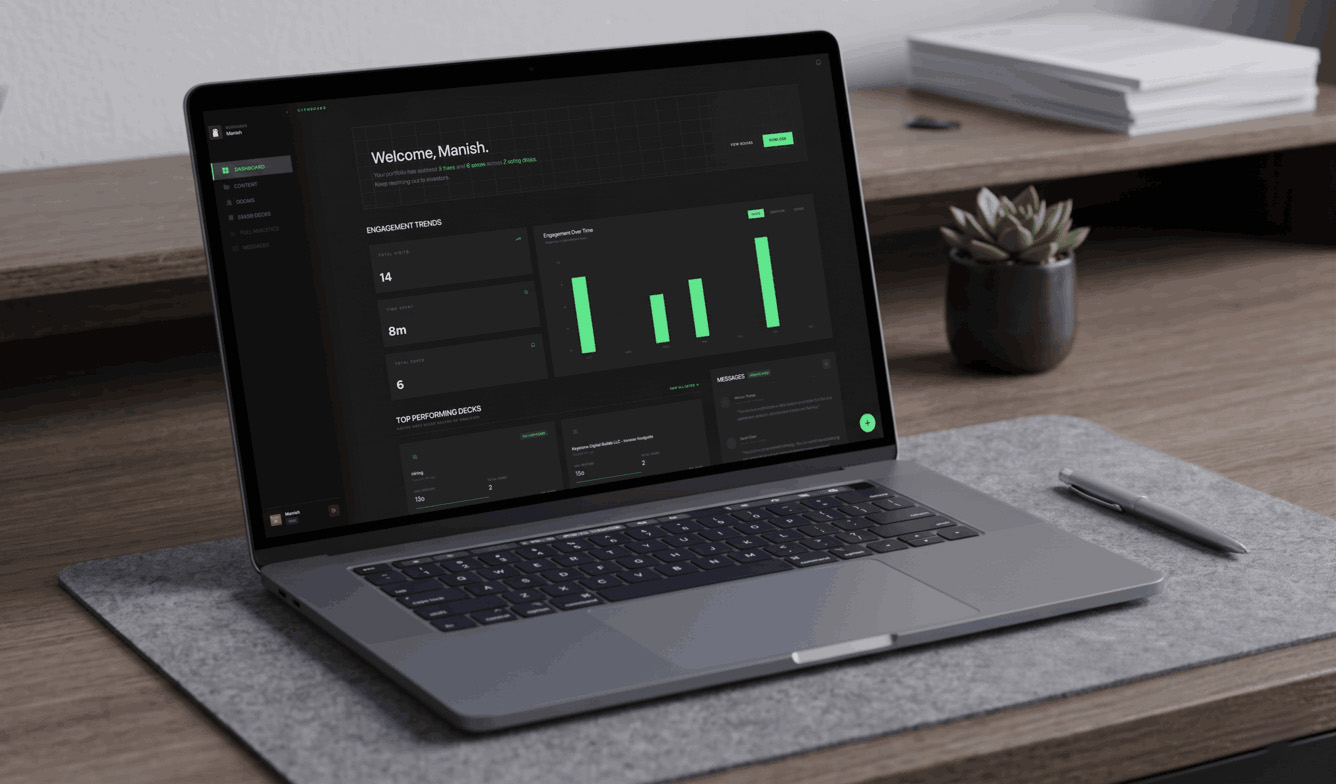
The point is keeping the fundraising workspace clean enough that founders and investors can move without friction — decks staged and shared at the right time, data rooms organized into folders instead of a flat file dump, and links you can tag, expire, or lock down as a conversation moves from a first call to real diligence.
That means deck sharing, analytics, folders, tags, version updates, and investor context all live together, instead of split across email, Drive, and a separate tracking spreadsheet.
The Practical Takeaway
If you are preparing for a pre-seed or seed round, build the smallest useful room first.
Get IP assignments signed before anyone asks for them, make sure your cap table actually reconciles with your SAFEs, and stage what you share instead of opening everything at once.
Then add depth only when the round actually needs it.
The goal is not to impress investors with a giant folder tree.
The goal is to make the next conversation easier.
FAQ
What documents should be in a startup data room first?
Start with company formation documents, the cap table and financing docs, current financials, the pitch deck, and core IP assignments.
Do early-stage founders need a huge data room?
No. Early-stage founders usually need a small, clean room that removes doubt without creating extra work.
Should every investor see the full data room?
Not immediately. Share the deck first, then open deeper access only when the investor shows real interest.
Related Reads
- What Is a Virtual Data Room? A Complete Guide for Startups
- Data Room vs. Simple Document Sharing: Which Does Your Fundraise Actually Need?
- Best DocSend Alternatives for Startups in 2026
- DocSend vs Papermark vs Deckly: Which Pitch Deck Tool Should Founders Use?