Pitch Deck Tracking: How to Read Investor Engagement and Follow Up
A practical guide to pitch deck tracking, investor engagement signals, page-level analytics, and deciding when and how to follow up.
You send your pitch deck and wait.
One investor opens it for twenty seconds. Another reads every slide. A third comes back three days later and spends most of their time on the financials.
All three count as views. They do not mean the same thing.
Useful pitch deck tracking is not about watching a notification counter. It is about combining views, page-level attention, repeat visits, and the context of the conversation to decide what to do next.
This guide explains what common engagement signals can mean, what they cannot prove, and how to follow up without sounding like you are monitoring every click.
The short answer
Do not make a decision from one event.
Use three layers of context:
- Delivery: Did the investor open the deck at all?
- Depth: How much of the deck did they review, and where did they spend time?
- Intent over time: Did they return, share it internally, ask a question, or signal interest?
The stronger signals usually combine more than one layer. A full review followed by a return visit is more useful than one long session. An explicit question is more useful than both.
A practical signal-to-action table
| Signal | What it might mean | What to do next | What not to assume |
|---|---|---|---|
| No view | The email was missed, filtered, or not prioritised | Check the link and send one short follow-up | The investor rejected you |
| Very short view | Accidental click, quick scan, or weak opening | Review the first slides and wait for more context | The whole deck failed |
| Most slides viewed | The investor gave the deck a real first pass | Follow up at the agreed time with one useful point | They are ready to invest |
| Repeat visit | The opportunity may be active again | Send a relevant update or question | A term sheet is coming |
| Time concentrated on one section | That section may matter or may be unclear | Prepare supporting detail for the next conversation | Attention always means approval |
| Several viewers | The deck may have been shared internally | Offer context for the wider team | Every viewer is a decision-maker |
| Consistent drop-off across many views | A slide or transition may be losing attention | Review that part of the story before the next batch | One person leaving proves the slide is bad |
| Explicit interest or direct question | The investor has taken an active step | Prioritise a direct response | Analytics matter more than the conversation |
Treat this table as a decision aid, not a scoring formula. Fundraising conversations are too different for one universal engagement score.
What pitch deck tracking actually measures
A tracked pitch deck link can give you information such as:
- whether the deck was opened
- when it was opened
- how many times the link was visited
- which pages were viewed
- time spent on individual pages
- where viewers stopped
- whether the deck was revisited
- who viewed it when email identification is enabled
- whether several viewers may have used the same distribution link
These events describe behaviour around the document. They do not explain the investor’s final opinion.
An investor may spend a long time on a slide because it is impressive, confusing, or interrupted by a phone call. A short session may mean low interest, or it may mean they already saw the deck during a meeting.
Tracking becomes useful when you connect the behaviour to what happened before and after the view.
Signal 1: the deck was not opened
No view is a delivery signal before it is an interest signal.
The email may have landed in spam. The investor may have saved it for later. An assistant may have forwarded the message without opening the link. The link may also be broken or restricted incorrectly.
Before following up:
- open the link in a private browser window
- confirm the deck loads without your account
- check password, email verification, and expiration settings
- confirm the email address and recipient
- make sure you sent the current link
If everything works, send one short follow-up after a reasonable gap. Two to four business days is a useful default for a cold or lightly warm introduction, but use the timing agreed in the conversation when there was a meeting.
Keep the message simple:
Sharing this again in case it was buried. The deck covers our product, current traction, and the round. Happy to answer any questions.
Do not write “I noticed you have not opened the deck.” The tracking is for your decision, not for pressuring the recipient.
For delivery problems specifically, read Why Your Pitch Deck Keeps Landing in Spam.
Signal 2: the investor left after the first few slides
A short visit tells you that the deck did not receive a complete review. It does not tell you why.
Possible reasons include:
- the investor clicked while busy
- the company did not match their thesis
- the opening slides took too long to explain the business
- the link was forwarded to someone doing a quick screen
- the investor already had enough context from a meeting
One short visit should not trigger a rewrite. A pattern across several relevant investors is more useful.
If viewers repeatedly leave before reaching the product or traction, check whether the opening answers these questions quickly:
- What does the company do?
- Who is it for?
- What painful problem does it solve?
- Why is the opportunity credible now?
- What evidence shows that the company is moving?
Do not add more slides automatically. The better fix is often a clearer first sentence, a simpler problem slide, or moving traction earlier.
Signal 3: most or all of the deck was reviewed
A complete review is a positive engagement event because the investor gave the material time. It is still not a commitment signal by itself.
The right follow-up depends on the conversation:
- After a meeting: send the promised materials and answer any open question.
- After a warm introduction: follow up with one specific reason the opportunity fits the investor.
- After cold outreach: avoid sending a message immediately after the view. Give the investor room to respond.
- After a requested deck: follow up on the timeline they gave you.
Do not mention exact viewing behaviour. “I saw you spent six minutes on the deck” feels intrusive and adds no value.
Use the information quietly. If the investor reviewed the whole deck, your next message can move the conversation forward instead of asking whether they received the file.
Signal 4: the investor returned to the deck
A repeat visit is often more useful than the first open because it shows the deck became relevant again.
The investor may be:
- preparing for another call
- comparing the company with another opportunity
- checking a number or claim
- sharing the opportunity with a partner
- revisiting the round after an internal discussion
Look for supporting context:
- Did the revisit happen after your product update?
- Did another person open the deck around the same time?
- Did the investor return to the same section?
- Is there an unanswered question from the last conversation?
If the investor revisits after a period of silence, follow up with something useful rather than a generic “checking in.” For example:
We have added two customers since we last spoke and updated the traction slide. I thought the timing might be useful given our earlier conversation.
The revisit creates a reason to prioritise the conversation. The business update gives the investor a reason to reply.
Signal 5: one slide receives unusual attention
Time spent on a slide is ambiguous. It can represent interest, confusion, or simple interruption.
The slide topic helps you interpret it:
- Problem or market: the investor may be testing whether the opportunity is large and urgent.
- Product: they may be trying to understand how the product works or differs from alternatives.
- Traction: they may be checking whether growth supports the story.
- Business model: they may be evaluating pricing, margins, or scalability.
- Financials: they may be reviewing assumptions, burn, runway, and the raise.
- Team: they may be checking whether the founders fit the problem.
Prepare for the next conversation by reviewing the evidence behind that slide. Do not assume you should immediately add more text to it.
If many viewers pause on the same page and then leave, the slide may need a clearer chart, definition, or transition. If they pause and continue, the slide may simply contain information worth studying.
Signal 6: the deck appears to have been shared
More than one viewer on a link can be a useful sign that the opportunity reached a wider group. It can also happen because the same person changed devices, browsers, or networks.
Use identified views and the surrounding conversation when available. If a partner, associate, or specialist appears after the first investor reviewed the deck, internal circulation becomes more plausible.
Your follow-up should make the review easier for the group:
If it would help the partnership discussion, I can share the product demo, cohort data, and a short note on our current round.
Do not ask who forwarded the deck or list the people you saw. Offer the next useful material and let the investor decide how to involve their team.
For cleaner attribution, create separate links for channels that matter—such as warm introductions, an accelerator, or a lead investor—while keeping the same current deck underneath. This guide explains how to update the deck without sending a new link.
Signal 7: viewers repeatedly stop at the same slide
A drop-off slide becomes useful when it appears as a pattern, not a single event.
Review the slide and the transition before it:
- Does the previous slide create an unanswered question?
- Is the slide crowded or hard to scan?
- Does it introduce a number without explaining the source?
- Does the story move from product to market without a clear connection?
- Does the deck become too detailed at that point?
- Has the investor already received enough information to make an initial decision?
Sometimes the slide is the problem. Sometimes the deck is simply longer than the first review needs to be.
Make one change at a time. If you rewrite several slides, change the order, and add new pages together, you will not know which change improved the pattern.
Record meaningful deck updates so you do not compare page-level analytics from two different layouts as if they were the same document.
Signal 8: the investor takes an explicit action
Direct actions carry more weight than passive analytics.
Examples include:
- replying with a question
- requesting a meeting
- asking for financials or a data room
- introducing a partner
- requesting a customer reference
- explicitly signalling interest
At this point, stop trying to infer intent from viewing behaviour. Respond to the action.
If the investor asks for supporting documents, move the conversation into an organised data room rather than sending a chain of attachments. The startup data room checklist explains what to prepare and what to hold back until diligence is real.
A simple follow-up framework
Use this order before sending any message:
1. Check the relationship
Was this cold outreach, a warm introduction, a post-meeting send, or active diligence? The same analytics event means something different in each situation.
2. Check the pattern
Was it one open or several? Did the investor finish the deck? Did they return? Did another viewer appear? One event gives you a clue. A sequence gives you context.
3. Find a useful reason to contact them
Good reasons include:
- answering an open question
- sharing a promised document
- reporting a meaningful company update
- clarifying a financial assumption
- offering material for an internal discussion
“I saw you viewed the deck” is not a useful reason.
4. Match the urgency to the signal
| Situation | Reasonable next step |
|---|---|
| No view after a few business days | One short delivery follow-up |
| One complete first view | Follow the expected conversation timing |
| Repeat visit after silence | Send a relevant update within the next business day |
| Several internal viewers | Offer supporting context for the group |
| Request for financials or legal material | Respond promptly and open controlled data-room access |
| Explicit interest or meeting request | Prioritise the direct conversation |
These are defaults, not rules. A committed lead investor should not be treated like a cold email because a dashboard event looks similar.
How to set up tracking so the data stays useful
Analytics quality depends on how you distribute the deck.
Use separate links for separate channels
Create different links when you need different access controls or attribution. Good examples are:
- warm introductions
- accelerator or demo-day outreach
- direct outreach
- lead-investor review
- strategic investors
Do not create a separate link for every person unless that level of control is useful. Too many links create their own management problem.
Name links clearly
Use names that still make sense later:
Seed 2026 — Warm introsLead investor — Partner reviewAccelerator — Demo dayStrategic — No download
Avoid names such as new link 2 or final share.
Keep the deck version current
If active links point to different copies of the deck, the analytics become harder to compare. Maintain one current source for the same story and record material updates.
Create a separate deck only when the audience, content, or historical record genuinely needs to differ.
Use identification controls deliberately
Email verification can improve attribution, but it adds friction. Use it when knowing who viewed the material matters more than making the first click effortless.
A warm introduction or active diligence process can justify stronger identification. Broad top-of-funnel sharing may need a lighter experience.
Common pitch deck tracking mistakes
Following up immediately after every notification
Fast is not always useful. A message sent minutes after an open can feel automated or intrusive. Use the signal to prioritise your work, then follow the natural timing of the conversation.
Treating time spent as a verdict
Duration does not explain sentiment. Combine it with pages viewed, repeat activity, direct questions, and the relationship.
Rewriting the deck after one short session
One viewer is an anecdote. Look for a repeated pattern among relevant investors before changing the story.
Using one public link everywhere
A single link across your website, email, events, and direct outreach makes attribution weak and access harder to control. Separate links by meaningful channel.
Creating a unique link for everything
The opposite is also a problem. If every send becomes another link, your workspace becomes difficult to maintain. Split links only when access, attribution, or revocation needs differ.
Mentioning surveillance in the follow-up
Do not quote exact view times, locations, or page behaviour back to the investor. Use analytics to make a better decision, not to make the recipient feel watched.
Ignoring the direct conversation
An investor who asks a detailed question is giving you a clearer signal than any page-view chart. Do not let the dashboard replace basic judgement.
How Deckly supports the full loop
Deckly connects the parts of pitch deck tracking that founders otherwise manage separately:
- share a current pitch deck through controlled links
- use separate links for different audiences without duplicating the file
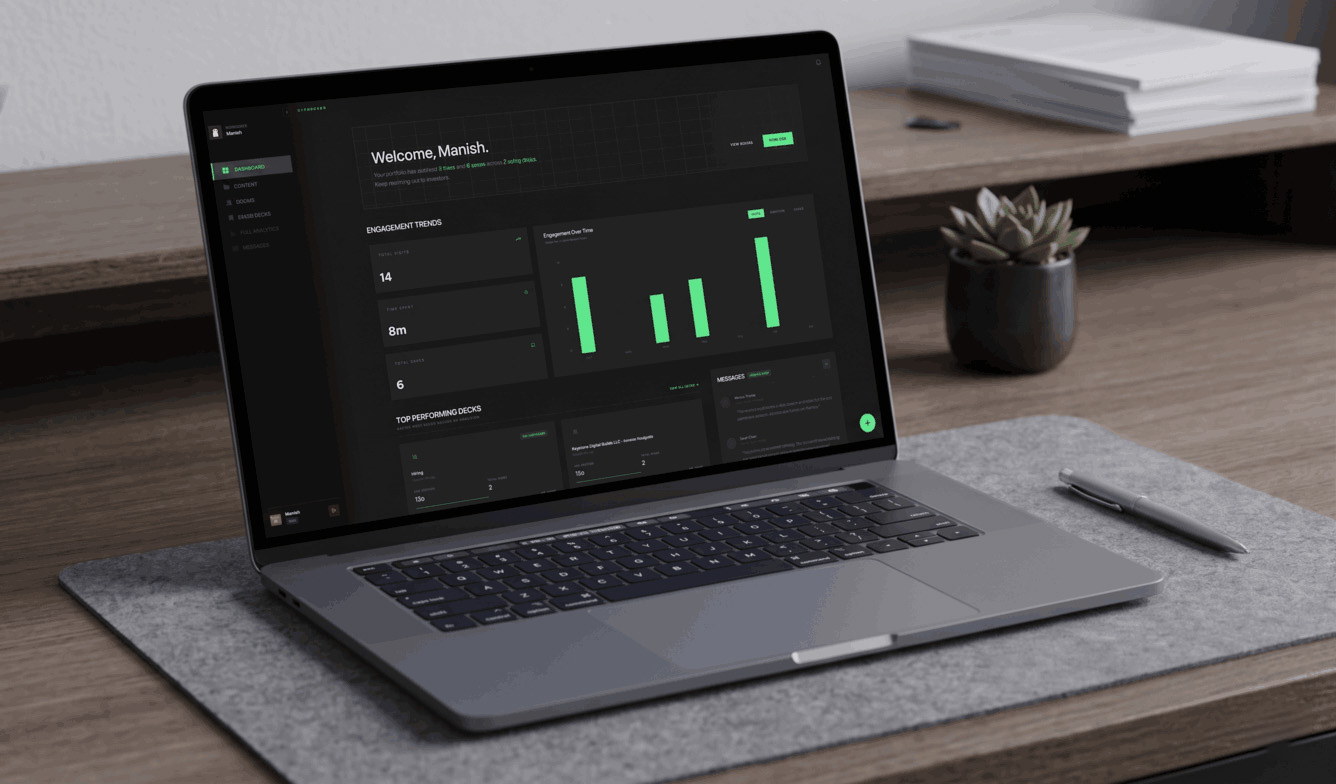
- review opens, revisits, time spent, and page-level attention
- identify repeated drop-off patterns
- organise investors, links, and documents with tags
- receive explicit investor interest signals when available
- move supporting documents into a data room when diligence begins
The point is not to collect more events. It is to answer practical questions:
- Did the investor receive the deck?
- Did they review enough to justify a follow-up?
- Which part of the story needs work?
- Is the opportunity active again?
- What should happen next?
If your analytics do not help answer one of those questions, they are probably noise.
A checklist before you follow up
- Confirm the link works and the investor received the right version.
- Check the relationship and expected timing.
- Look for a sequence of signals, not one event.
- Review the pages that received attention or lost it.
- Find a useful reason for contacting the investor.
- Keep the message focused on the company, not the tracking data.
- Respond to direct actions before interpreting passive analytics.
- Record the next step so the context is not lost.
FAQ
What is pitch deck tracking?
Pitch deck tracking is the use of a shared link to understand whether a deck was opened, which pages were reviewed, how long viewers spent, where they stopped, and whether they returned. Available data depends on the sharing platform and access settings.
Can I see who viewed my pitch deck?
You can identify viewers when the link requires an email or another form of verification. Anonymous links may show activity without reliably identifying the person behind every visit.
Does a repeat view mean an investor is interested?
It is a stronger engagement signal than a single open, but it is not proof of investment intent. Combine it with the conversation, page activity, questions, and any direct action.
When should I follow up after an investor views my deck?
Follow the timing of the relationship. After cold outreach, avoid reacting immediately to a view. After a repeat visit or meaningful update, a relevant follow-up within the next business day can be reasonable. Respond promptly when the investor asks a direct question or requests material.
Should I tell an investor that I tracked their deck activity?
Usually no. Use the data privately to improve your timing and preparation. Keep the follow-up focused on useful information, open questions, and the next conversation.
What is a pitch deck drop-off slide?
It is the page where viewers most often stop progressing through the deck. A repeated drop-off pattern can help you identify a weak transition, an unclear slide, or a deck that becomes too detailed.
The takeaway
Pitch deck tracking cannot tell you exactly what an investor thinks. It can tell you whether the deck was delivered, how deeply it was reviewed, whether attention returned, and where the story may need work.
Use those signals to choose a better next action. Check delivery before assuming rejection. Look for patterns before rewriting slides. Follow up with useful context instead of mentioning the tracking event.
Deckly brings the current deck, controlled links, page-level analytics, drop-off context, investor signals, tags, and data rooms into one fundraising workspace. The goal is not more notifications. It is a clearer answer to what should happen next.