Why I Built Deckly
The fundraising stack was broken — too expensive, too fragmented, and giving founders almost no useful data. We built Deckly to fix that.
The idea was born from frustration, not from market research or some next million-dollar idea. It came from a very simple frustration: paying so much for a process that should have been far simpler, from preparing and sending pitch decks to investors to dealing with all the friction around it.
I was a first-time founder, traveling through this new fundraising ecosystem with no contacts at all and no real idea of how to approach it. I did basic research, started applying on different platforms, and began cold emailing. How naive I was to think that making a good game was enough for fundraising.
I did raise successfully, but that is a different story for another day. I am still a gamer at heart. So if a fellow gamer is reading this, keep grinding.
What I learned is how tiring fundraising is for founders, and how every simple tool seems to get in the way. Especially if you are a first-time founder trying to raise, you are suddenly introduced to a new world where everything is very, very different.
After becoming friends with investors and VCs, I realized that they have it hard too. It gets frustrating hearing that their food delivery app is better than others, or that this social network will kill Instagram, or that this dating network matches you better. Basically, we all know how tiring fundraising is: meetings after meetings, sending and managing multiple documents, then using apps like DocSend and Papermark, and getting charged hundreds of dollars for simple document management while they keep getting in the way of both founders and investors.
I was also managing multiple data rooms, sharing different types of docs, keeping track of everything, updating the docs, and then telling the investor, “Please check the updated version.” And everything becomes tiring.
It is not that these tools are bad. They are just not built for this specific workflow. My philosophy is that a tool should never get in your way. Its job should be to help you get work done as quickly and efficiently as possible. Yet all these platforms keep getting in the way.
Out of that simple frustration, Deckly was born. I did not want another tool to add to the stack. I decided to build a workflow specifically for fundraising, where both founders and investors can treat it as a document workspace, not just a place for sending or viewing decks.
What Deckly Is Trying to Be
Deckly is not a CRM, not a file host, and definitely not a DocSend clone.
Deckly is trying to become a workspace for all your startup-related document management. Its goal is to help founders manage all their data and help investors manage it on their own terms, while also making it easier for them to decide whether they want to invest or not, and do it quickly.
Some Features I Think Are Worth Checking Out
FOUNDERS: I have built workflow-specific features for both investors and founders. If you are a founder and have used DocSend or Papermark, you will feel right at home, but with some core thinking changes.
We give you a global tags feature so you can tag any document with labels like “Seed Round” or “Investor 1” and then filter and search those documents. These tags are visible only to you, so you can manage your docs properly.
So let us say you have seven different copies of decks for different types of investors and you do not know which one to update because Investor 1 asked for some changes. Well, now you can easily filter by tags or search by name.
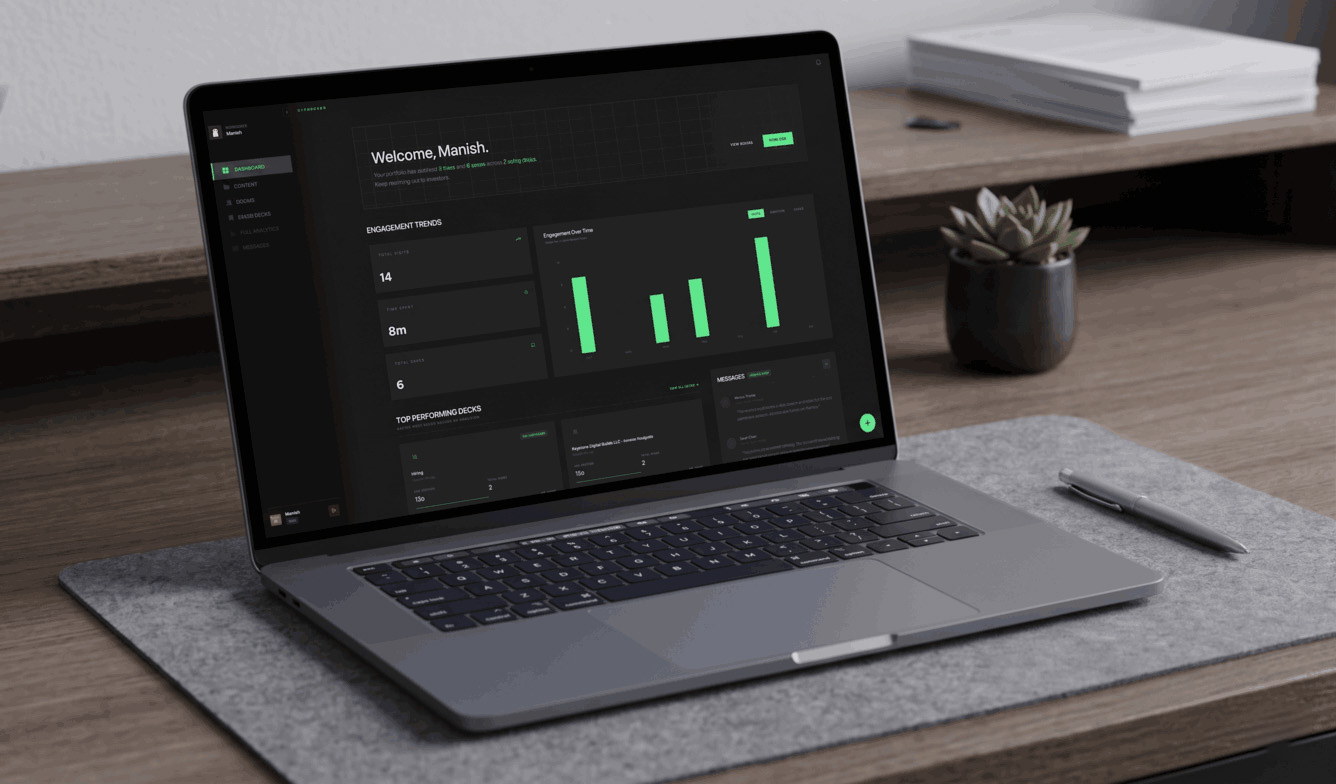
You also get detailed page-by-page analytics with location and time spent on each page. Another feature we built is called the “Drop-off Slide,” where you can see on which slide most viewers are exiting the document. That is a goldmine of insight as a founder.
Something else we do is give you five different types of signals on decks, which help you determine whether someone has viewed your deck multiple times, forwarded it, or revisited it after some time. All these signals help you figure out whether someone is actually interested or not.
Alongside these, I have built many quality-of-life features like creating folders inside data rooms, tagging those folders, and viewing a data room analytics overview. And yes, this does have AI integrated into it, becoming live soon.
INVESTORS: We have also built some unique quality-of-life features for investors. As an investor, most of the time you only see a few pages of a deck and already know whether it will work for you or not. These features are for that 1% of the time when you think it might work.
Instead of downloading and saving documents, you can save the docs directly on the platform, write notes on the deck privately for you and your team, create folders and organize them there, and add tags to organize things by stage, sector, interest, and more.
You can also simply ask AI to summarize it for you and ask questions related to the deck, like whether the projection is correct or too aggressive. When a founder updates a deck, you see a small notification on the deck, which you can turn on and off for individual decks or globally, so you never miss an update from the team.
You can send a direct message to the founder if you need another document, and arrange a meeting from the same place. Basically, it is a workspace where you do not need to jump across 10 different tools and get the deck section out of the way. Because as an investor, you invest in the founder, not just the idea.
Should You Try Deckly?
Yes, Deckly is still in alpha, but it is ready for real work use. If you are raising or if you are an investor, it will make your life much easier.
Another advantage is that we do not charge 100s of dollars for basic data room features. Even the free version is enough for most early-stage founders, while the basic plan is enough for 90% of startups at the early stage.
Most of all, you will feel a lot less frustrated about whether people are seeing your document or how they are behaving around it.
All I ask in return is that you send us feedback, tell us what other features you would like to see, and share this with your fellow founders and investors.
Deckly — where founders meet investors.