Data Room vs. Simple Document Sharing: Which Does Your Fundraise Actually Need?
Data room vs. document sharing: learn what each option is built for, when a startup needs a full VDR, and what most pre-seed and seed fundraises actually require.
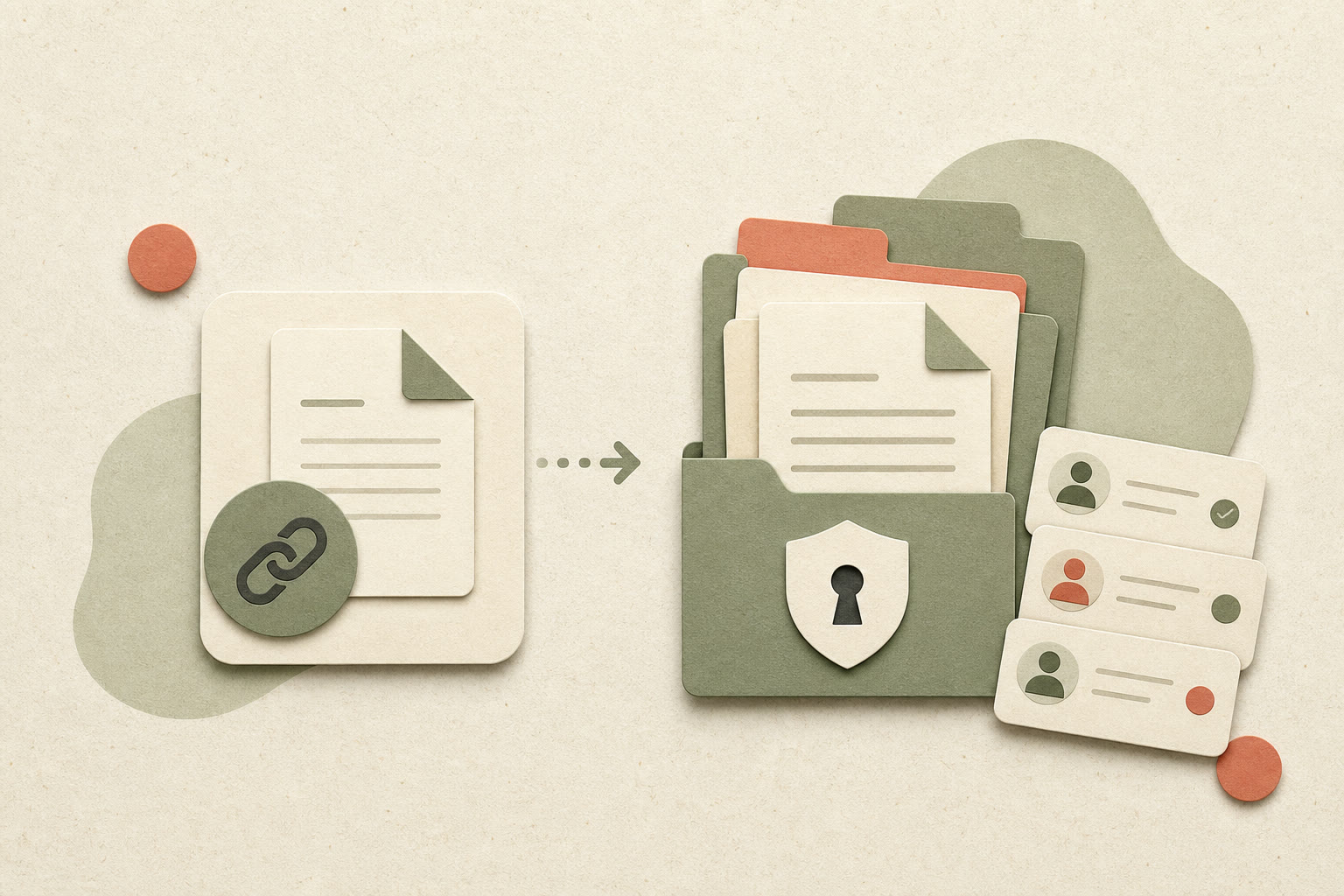
Somewhere around the second or third investor conversation, a lot of founders hit the same quiet panic: is a Google Drive folder embarrassingly unprofessional, or is a $500-a-month enterprise data room wildly overbuilt for a round that is still mostly exploratory calls?
Neither instinct is wrong, exactly. They are just answering a different question than the one that actually matters: do you need simple document sharing or a full virtual data room for the work happening right now?
Data room vs. document sharing at a glance
| Simple document sharing | Full virtual data room | |
|---|---|---|
| Best for | Early conversations and lightweight review | Structured multi-party diligence |
| Typical content | Pitch deck, one-pager, updates | Financials, contracts, cap table, IP, legal files |
| Access control | Link-level or file-level controls | Granular folder and document permissions |
| Activity history | Opens and basic engagement | Detailed audit trail of views and downloads |
| Investor workflow | Share and review | Review, diligence, questions, and controlled access |
| Cost fit | Pre-seed and seed-friendly | More appropriate when diligence is complex |
| Main risk | Too little structure for sensitive files | Too much cost and administration too early |
The right choice depends less on how impressive the platform looks and more on how many people need different access to how sensitive a document set is.
What simple document sharing actually is
Simple document sharing is usually a link. It may include page-view analytics, an expiration date, download controls, or basic access management.
For an early investor conversation, that may be exactly enough. You can share the current deck, see whether it was opened, and follow up without sending a PDF attachment into an inbox.
What it usually does not include is deep control over every part of the review. You may not be able to:
- give different people access to different folders
- create a detailed history of every view and download
- watermark every sensitive document
- revoke one person’s access without changing everyone else’s
- manage a structured diligence Q&A process
That is not necessarily a flaw. If you are sharing a pitch deck with one investor, you may not need those controls yet.
What a full virtual data room adds
A full virtual data room adds structure and control on top of file sharing. Depending on the provider, that can include:
- folder- or document-level permissions
- audit logs for views and downloads
- dynamic watermarking
- download restrictions
- email verification and two-factor authentication
- access expiration and revocation
- structured Q&A for diligence questions
- more deliberate workflows for external legal and finance teams
This is the tooling built for situations where multiple external parties — investors, their lawyers, your lawyers, and sometimes accountants — are cross-referencing the same materials at the same time.
An audit trail matters more when someone may later ask who accessed a sensitive document, when they accessed it, and whether it was downloaded. It matters less when the only file in the room is your public-facing pitch deck.
The question that actually decides it
Do not decide based only on whether your round feels “serious.” Look at the concrete work happening around the documents.
How many people need different access at once?
A single investor casually reviewing a deck needs very little permission complexity.
Three investors, two lawyers, and an accountant reviewing a cap table and IP assignments is a different situation.
The more people involved — and the more their access needs differ — the more useful a full data room becomes.
What stage is the conversation at?
Early exploratory calls rarely need more than a tracked link and a clean current deck.
Once you are past initial interest and into structured diligence, the calculation changes. If someone is methodically working through financials, contracts, and legal documents, a missing audit trail can create real work rather than merely making the process look less polished.
What is actually in the room?
A pitch deck and a data-driven one-pager have a different sensitivity level from a full cap table, signed customer contracts, and IP assignment documents.
Ask what would happen if the wrong person saw or downloaded each file. The more damaging that scenario would be, the more granular controls become a practical requirement rather than a nice-to-have.
Is anyone external going to audit the access history?
If nobody is likely to ask who saw a document and when, a full audit-log system may be solving a problem you do not have yet.
That does not mean security is unimportant. It means the tool should match the real risk and workflow instead of adding ceremony for its own sake.
Where most fundraising founders actually land
For a typical pre-seed or seed round, you rarely need the full enterprise VDR on day one. You need something more capable than a raw folder link:
- real engagement tracking
- access control and revocation
- a current deck that does not require a new URL after every edit
- enough organization to make the review feel deliberate
- a clean path to a data room when diligence becomes real
That middle ground is a real category, not a compromise. It is what a fundraising-specific workspace is for: more useful than bare-bones sharing, without paying for M&A infrastructure before you are running an M&A-style process.
A simple decision framework
Use simple document sharing when most of these are true:
- the conversation is exploratory
- the main asset is a pitch deck or short update
- one person or a small team is reviewing it
- everyone can see the same material
- basic engagement tracking is enough
- there is no immediate need for a full audit trail
Start a full virtual data room when several of these become true:
- multiple external parties need different access
- investors are reviewing legal, financial, and customer documents
- counsel or accountants are involved
- downloads and document history need to be controlled
- diligence questions are arriving in a structured way
- a buyer, lead investor, or board requires formal access records
The transition does not have to happen all at once. A good fundraising workspace can handle the early deck link and the later data room in the same overall workflow.
Why the middle ground matters
The cost of under-building is obvious: files are scattered, versions get stale, and investors ask for documents one email at a time.
The cost of over-building is quieter:
- more software to configure
- more folders to maintain
- higher monthly pricing
- more permission decisions than the team needs
- more time managing the room instead of talking to investors
The goal is not to make a seed round look like a public-company transaction. The goal is to give investors a clear, secure way to review the material that is appropriate for the stage of the conversation.
How Deckly fits between the two
Deckly is built for the middle of this workflow: a fundraising workspace that starts with pitch deck sharing and can grow into structured document review.
Founders can share a current deck, track page-level engagement, control access, organize documents, and create data rooms when the conversation moves into diligence. Investors get a cleaner place to review, save, organize, and return to the material they receive.
That means you do not have to choose between a bare link and an enterprise VDR before you know which problem you actually have.
For a deeper explanation of the room itself, read What Is a Virtual Data Room?. If you are preparing for a seed raise, the Startup Data Room Checklist covers the documents worth organizing first.
FAQ
What is the difference between a data room and document sharing?
Document sharing focuses on securely sending and reviewing files. A full data room adds granular permissions, audit logs, watermarking, download controls, and structured diligence workflows for more complex document access.
Do pre-seed startups need a virtual data room?
Usually not a full enterprise VDR at the beginning. A tracked, controlled document-sharing workflow is often enough for early conversations. Move to a more structured room when investors request sensitive files or multiple external parties need different access.
Is Google Drive enough for fundraising?
Google Drive can work for a small, low-sensitivity document set. It becomes less suitable when you need investor analytics, controlled access, version clarity, document-level permissions, or a more deliberate diligence workflow.
When should I create a data room?
Prepare the structure before investors request it, but expand access when conversations become serious. That lets you respond quickly without exposing every sensitive document during the earliest stage.
Is a virtual data room worth the cost?
It can be worth the cost when multiple external parties are reviewing sensitive documents and an audit trail or granular permissions matter. It is often unnecessary when the main job is sharing a deck and tracking investor engagement.
Can one fundraising tool handle both a deck link and a data room?
Yes. A fundraising-specific workspace can support lightweight deck sharing early and structured data rooms later, allowing founders to keep the workflow and document context in one place.
The takeaway
The right question is not whether your fundraise looks serious enough for a data room. It is whether the people, documents, and access requirements have become complex enough to justify one.
Use simple document sharing while the conversation is mostly about the deck. Add a structured data room when diligence becomes multi-party, sensitive, and auditable.
Most founders do not need the biggest room. They need the right amount of control at the right time — with a clean path to add more structure when the round actually requires it.