Why Your Pitch Deck Keeps Landing in Spam
Learn why pitch deck attachments get flagged, why sending a link is not always enough, and how founders can improve deck deliverability and investor visibility.
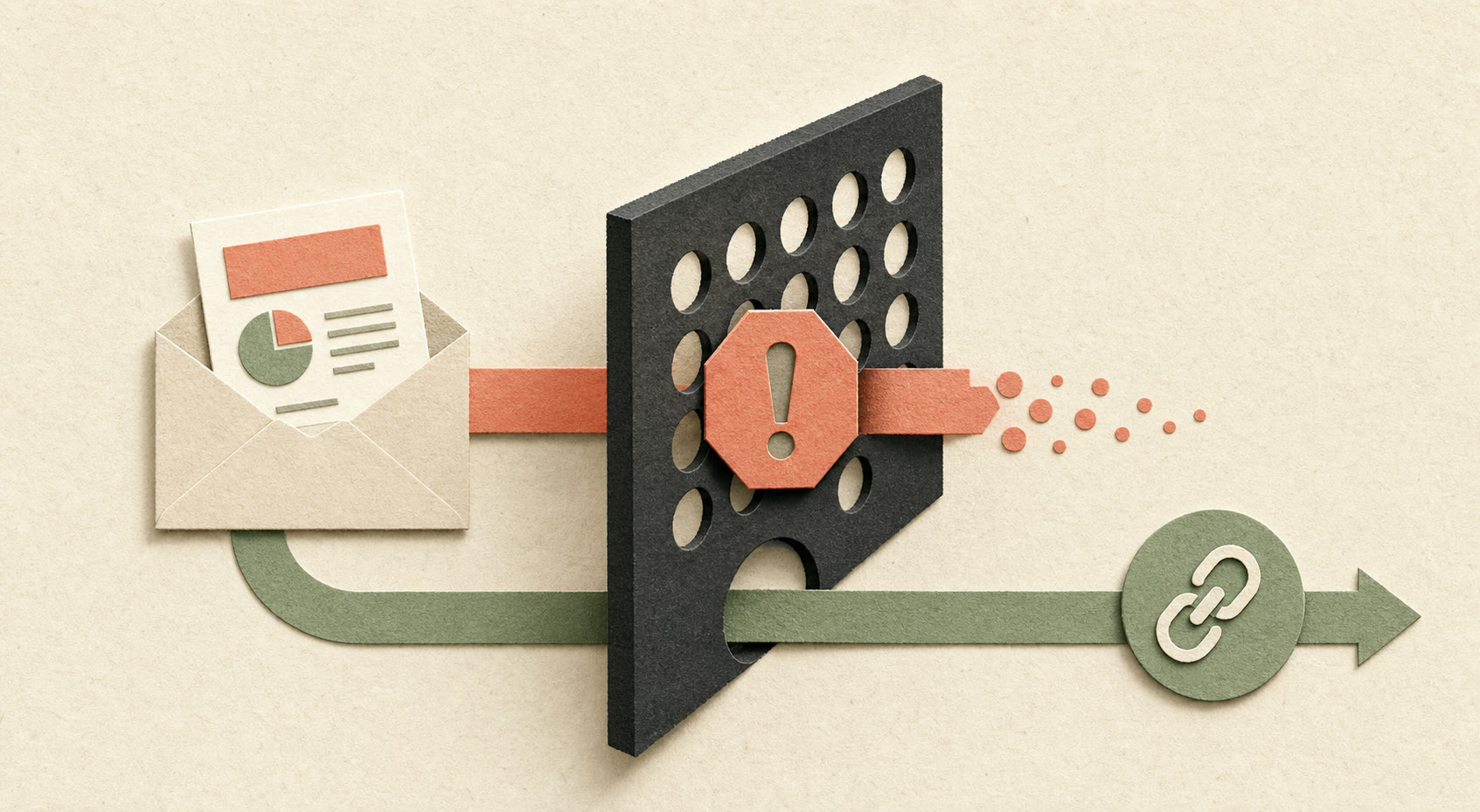
You send your pitch deck as a PDF attachment, follow up a week later, and hear nothing. Not a rejection — nothing. Then you find out the investor never saw it. Your pitch deck landed in spam, or never reached their inbox at all.
If you are searching for a pitch deck spam filter fix, the usual advice is “stop attaching PDFs and use a link instead.” That is directionally right, but it skips over why this happens — and why switching to just any link is not automatically the solution.
Why PDF attachments get flagged
PDF-plus-HTML emails attract more scrutiny
Email providers have become more cautious around phishing campaigns that combine PDF attachments with HTML content and suspicious links. That broader security climate can affect legitimate fundraising emails too.
If a deck that delivered reliably a year ago now gets blocked or filtered more often, the problem may not be the quality of your deck. It may be the combination of an unfamiliar sender, a PDF attachment, and the patterns around the email itself.
Spam filters score more than the deck content
Your deck can be clean, well-designed, and completely legitimate while still being evaluated alongside other signals:
- attachment presence
- file size
- sender reputation
- recipient engagement history
- link and domain reputation
- wording and formatting patterns associated with bulk email
The filter does not understand that your 18-slide market map is different from a malicious document. It sees a set of signals and makes a probability calculation.
One bad delivery can affect future emails
Email providers track sender reputation over time. If messages from your address repeatedly get marked as spam, future emails may become more likely to be filtered — including messages to recipients who have never reported you.
That makes deck deliverability part of your fundraising process, not just an email housekeeping issue. A deck that fails to arrive can create a false signal: you may interpret silence as investor disinterest when the investor never had a chance to review the material.
Why “just send a link” is not the full fix
Switching from an attachment to a link is usually an improvement. It removes the file from the email itself and gives you more control over the document experience.
But links get scrutinized too — just differently.
Enterprise email security checks the reputation of the domain a link points to. It can also inspect redirect chains. A link that passes through several unfamiliar domains before reaching the deck may look more suspicious than a direct link to an established destination.
That means these two links do not necessarily carry the same trust:
- a direct link from a dedicated, established sharing platform
- a personal file-sharing link on a new or heavily abused shared domain
The format changed, but the trust question remains: where does this link go, and what does the receiving system know about that destination?
A practical pitch deck deliverability checklist
Before you send your next investor email, check the basics:
- Skip the raw PDF attachment. This removes the biggest file-related risk you control.
- Use one direct sharing link. Avoid unnecessary redirects, URL shorteners, and a chain of tracking services.
- Pay attention to domain reputation. A dedicated, established sharing platform is generally more credible than an unfamiliar ad hoc file link.
- Keep the email simple. A short note with one clear link looks more legitimate than a heavily formatted message with multiple calls to action.
- Use a recognizable sender address. Sending from a domain connected to your company is easier for recipients and filters to understand than a newly created or inconsistent address.
- Give the link context. Say what the recipient will see and why you are sending it.
- Track actual opens. Silence is ambiguous. A tracked link helps you distinguish “not interested” from “never saw the deck.”
What a good investor email looks like
Your email does not need to be a mini landing page. In many cases, the cleaner version is better:
Hi [Name] — following up on our conversation about [specific context]. Here is the current version of our pitch deck: [direct link]. The short version is [one-sentence company description]. Happy to answer any questions.
Best,
[Your Name]
One clear link, one sentence of context, and an obvious reason for the recipient to open it is enough. The deck should do the heavy lifting once the investor arrives.
Visibility matters after deliverability
Getting the email into the inbox is only the first step. You also need to know what happened after you sent it.
Did the investor open the deck? Did they return to the same slide? Did they stop at the market-size section? Did they share it with someone else on their team?
A plain PDF attachment gives you almost none of that context. A link-sharing workflow can show whether the deck was opened and which parts held attention. That turns a week of silence into a better-informed follow-up decision.
Deckly gives founders one workspace for pitch deck sharing, page-by-page analytics, investor interest signals, and document versions. It helps you understand whether a deck was actually seen before you decide what the silence means.
For a broader look at this problem, read Fundraising Is a Black Box or compare the best DocSend alternatives for startups.
FAQ
Why does my pitch deck keep going to spam?
Common causes include sending a PDF attachment, using an unfamiliar sender domain, including several links, triggering content patterns associated with bulk email, or linking to a domain with weak reputation. It may also be the recipient’s own email-security policy rather than anything wrong with your deck.
Should I send my pitch deck as a PDF or a link?
For most cold or warm investor outreach, a direct link is safer and more useful than a raw PDF attachment. It reduces attachment-related filtering risk and lets you track whether the deck was opened.
Are pitch deck tracking links safe to send?
They can be, provided the destination domain is reputable, the link is direct, and the email clearly explains where it leads. Avoid hiding the destination behind unnecessary URL shorteners or multiple redirects.
Can I know if an investor saw my pitch deck?
You can get much better visibility with a tracked sharing link than with an email attachment. Depending on the tool, you may see opens, page-level engagement, return visits, or other investor interest signals.
What should I do if an investor says they never received my deck?
Resend a short plain-text email with one direct link, confirm the recipient address, and ask them to check spam or quarantine folders. Do not send the same PDF attachment repeatedly if the first one failed.
The takeaway
Your pitch deck can be excellent and still disappear before an investor sees it. Deliverability depends on the attachment, the email, the sender reputation, and the destination link — not just the quality of the document.
Send one direct link, keep the message simple, and track whether the deck was actually opened. That gives you a much cleaner signal than waiting in silence and guessing what happened.